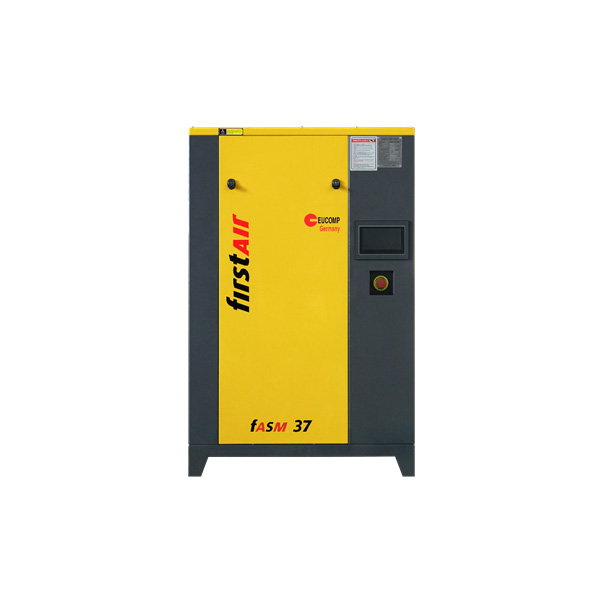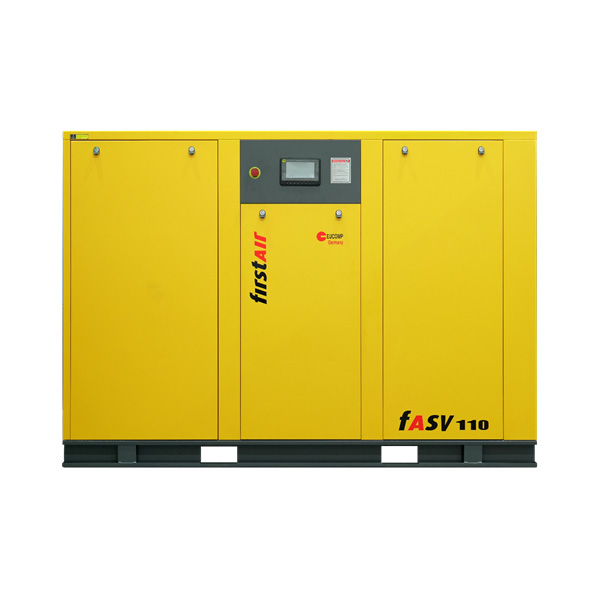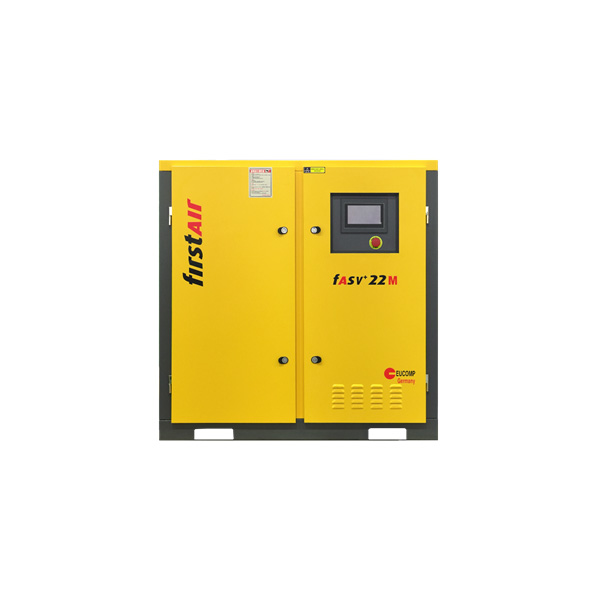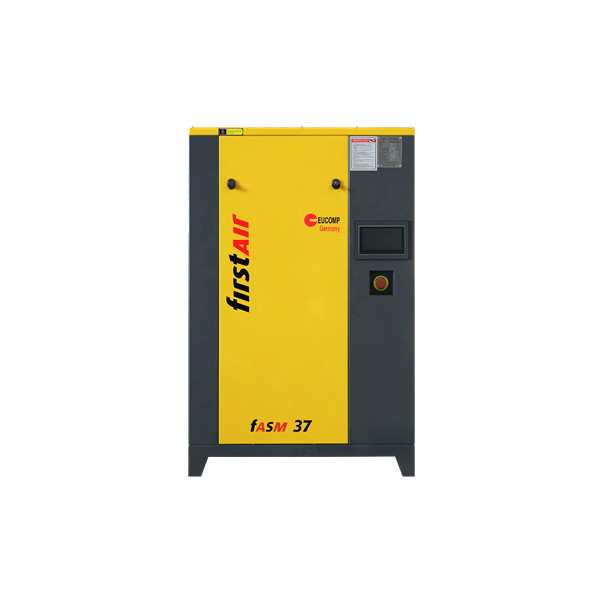
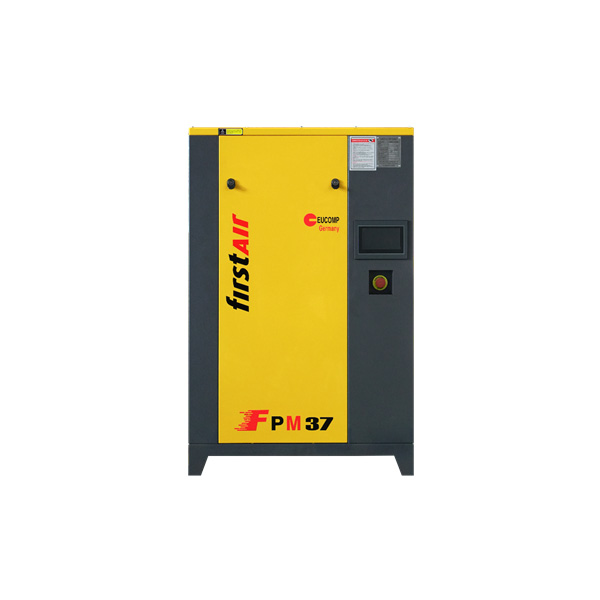
A permanent magnet motor has one widely acknowledged weak spot: it dislikes high temperatures. If temperatures stay high for long, the permanent magnets risk demagnetisation; once that happens, motor efficiency and reliability both drop noticeably, and the damage is usually irreversible. For plants that run continuously year-round, keeping motor temperature within a reasonable range is work that no PM VSD air compressor can avoid.
The ESSENCE FPM oil-cooled PM VSD screw air compressor is designed specifically around this point. It controls the temperature of the permanent magnet motor by oil cooling, with power from 7.5 to 75 kW, air delivery of 0.33-13.80 m³/min, working pressure of 0.7-1.25 MPa, and models from FPM08A-* up to FPM75A-*. For workshops with larger air demand, whether a PM model can hold its efficiency over the long term depends closely on the motor's own heat dissipation design.
PM VSD is popular because it makes "produce as much air as you use" possible, cutting no-load waste at the source. But this advantage comes with a precondition: the motor itself must be reliable enough. If a motor runs at high temperature for long, its efficiency decays, its failure rate rises, and the energy savings are cancelled out by downtime losses. The difference between PM models, then, often shows up precisely in the cooling method.
The "oil-cooled" in the FPM name points directly to the motor cooling method. Compared with relying on air convection, oil cooling carries heat away from the motor more directly and more steadily, keeping the motor's temperature rise within a reasonable range — reducing demagnetisation risk and extending service life. For workshops with continuous air demand and higher ambient temperatures, the value of this design compounds with running hours rather than staying on the specification sheet. Cooling looks like a detail, yet it directly determines whether a permanent magnet motor can hold its factory efficiency over the long term.
The FPM series spans 7.5 kW all the way to 75 kW, tiered at 7.5, 11, 15, 18.5, 22, 30, 37, 55, and 75 kW, with a corresponding air delivery range of 0.33-13.80 m³/min. Air outlet sizes step up from G3/4 to G2, matching the flow of each power band. This span means a plant can move from a single unit to centralised supply for a whole workshop within the same series, cutting the spare-parts and management costs that come with a mix of models. For businesses whose air demand sits in the middle range, this one-line lineup avoids the awkwardness of small plants using undersized machines while larger ones cobble together several brands.
Like most screw models, FPM offers four pressure tiers — 0.7, 0.8, 1.0, and 1.25 MPa — within the same model, with air delivery falling as pressure rises. This is inherent to screw compression: the higher the compression ratio, the less air is available for output. In selection, first establish the pressure the process uses most, then check air delivery at that pressure, avoiding the gap of "enough on the nameplate, not enough in practice." Getting the relationship between pressure tier and air delivery clear is the most effective step in avoiding selection errors.
FPM uses coaxial direct drive, with the motor connected directly to the airend — high transmission efficiency, a simple structure, and fewer day-to-day maintenance items such as belt aging and tensioning. Voltage/frequency is 220/380/415/440V, 50/60Hz, covering a range of power supply standards. The aftercooler outlet temperature is held at "≤ ambient + 15°C," easing the load on downstream drying and filtration equipment and making energy consumption across the whole air system more manageable.
Taken together, FPM puts its emphasis in two directions: first, temperature control of the permanent magnet motor; second, the breadth of its power coverage.
| Item | Specification |
|---|---|
| Working pressure | 0.7 ~ 1.25 MPa |
| Air delivery | 0.33 ~ 13.80 m³/min |
| Power range | 7.5 ~ 75 kW |
| Start method | PM VSD start |
| Voltage/frequency | 220/380/415/440V, 50/60Hz |
| Drive | Coaxial direct drive |
| Aftercooler outlet temperature | ≤ ambient + 15°C |
Competition in PM VSD is shifting from "do you have VSD" to "can the motor be relied on." FPM answers the high-temperature problem that permanent magnet motors fear most with oil cooling, then covers mid-to-large air demand scenarios with a wide 7.5-75 kW power range — for plants that weigh continuous operation above purchase price, it is an option worth adding to the shortlist.
| Starting Method | Type: PM VSD start |
|---|---|
| Voltage / Frequency | V/Hz 220/380/415/440V、50/60Hz |
| Aftercooler Outlet Temperature | °C ≤ ambient temperature +15 °C |
| Drive Method | Coaxial direct drive |
| Working Pressure | 0.7~1.25 MPa; air delivery 0.33~13.80 m³/min; power range 7.5~75 kW |
| Working Pressure | 0.7~1.25 MPa |
| Air Delivery | 0.33~13.80 m³/min |
| Power Range | 7.5~75 kW |




Give us your working pressure, air demand and site conditions, and we will confirm the model and configuration