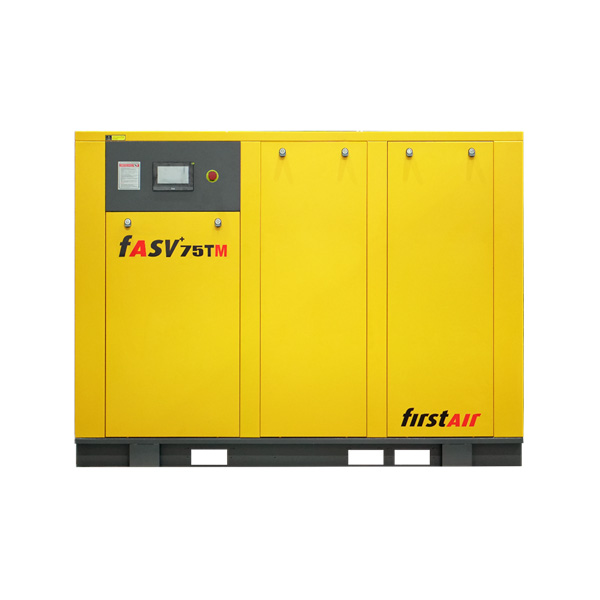
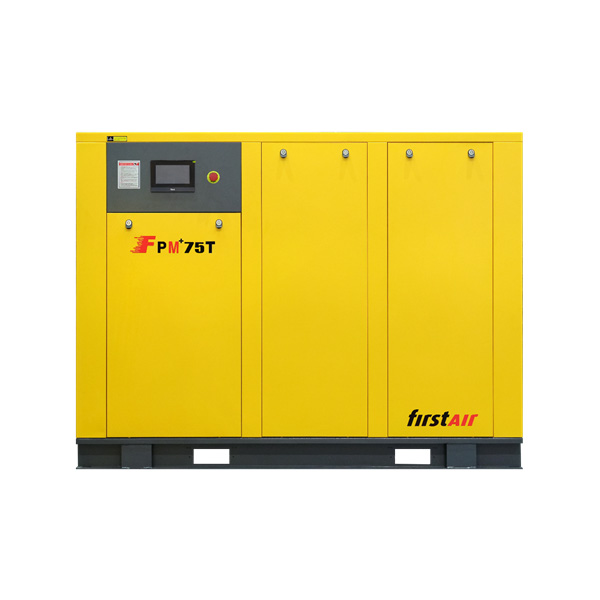
The energy consumption of compressed air comes down to one thing: compressing the gas to the target pressure. In single-stage compression, the entire pressure ratio is applied to a single pair of rotors in one step. The compression process heats up quickly, the single-stage pressure ratio is high, and the gas that flows back between the rotors (internal leakage) increases accordingly, which limits efficiency. The higher the power, the more pronounced this problem becomes.
The ESSENCE FPM+-T two-stage oil-cooled PM VSD screw air compressor tackles this problem through staged compression. It covers three models — FPM+55A/W-*T, FPM+75A/W-*T and FPM+90A/W-*T — with power from 55 to 90 kW, a working pressure of 0.7–1.25 MPa and air delivery of 3.76–20.80 m³/min, using PM VSD starting and coupling drive.
Two-stage compression means dividing the compression of air into two stages and cooling the air between them. The benefits can be broken down into three points:
In other words, two-stage compression is not an extra step added for its own sake; it does the same job in a gentler way, recovering the efficiency that would otherwise be lost to high temperatures and backflow.
The FPM+-T uses PM VSD starting and an oil-cooled design. Permanent magnet motors are sensitive to temperature, and prolonged exposure to high heat can affect both their efficiency and their reliability. Oil cooling keeps the motor's temperature rise within a reasonable range, so the advantages of PM drive hold up during long, continuous operation.
Combined with VSD control, the unit's speed follows air demand: when demand drops, speed and energy consumption fall; when demand rises, speed increases to keep pace with the air required, avoiding the unloaded waste of a fixed-speed machine's load/unload mode.
Unlike smaller units, models above 55 kW need to be planned for at the installation stage. The three FPM+-T models have net weights of 2350 kg, 2520 kg and 2950 kg, with overall dimensions (L × W × H) of 2250 × 1344 × 1694 mm, 2250 × 1344 × 1694 mm and 2300 × 1450 × 1750 mm respectively.
This means floor load capacity, access routes and lifting conditions all need to be confirmed before purchase. The three models occupy similar floor space, but the 90 kW model is slightly larger in length, width, height and weight, so the layout should be calculated for the actual model rather than estimated from the smallest in the series. These details, which seem unrelated to performance, are often exactly what determines whether the equipment can be installed smoothly.
The FPM+-T comes in three power steps — 55, 75 and 90 kW — as the models FPM+55A/W-*T, FPM+75A/W-*T and FPM+90A/W-*T. At 0.8 MPa, for example, the three models deliver 4.80–12.00, 6.60–16.50 and 8.00–20.00 m³/min respectively, with fairly even steps between adjacent ratings.
This focused line-up targets a clearly defined operating range: the 55–90 kW band is exactly where the main compressors of many mid-sized factory air stations sit. Rather than spreading out a long list of models, it makes more sense to make each power point solid within this band — a common approach for two-stage compressors.
| Item | Specification |
|---|---|
| Working pressure | 0.7–1.25 MPa |
| Air delivery | 3.76–20.80 m³/min |
| Power range | 55–90 kW |
| Power steps | 55 / 75 / 90 kW |
| Compression | Two-stage |
| Starting | PM VSD |
| Voltage / frequency | 220/380/415/440 V, 50/60 Hz |
| Drive | Coupling drive |
| Aftercooler outlet temperature | ≤ ambient + 15 °C |
| Air outlet | G2 / square flange DN80 |
| Dimensions | 2250 × 1344 × 1694 to 2300 × 1450 × 1750 mm |
| Net weight | 2350–2950 kg |
Taking the 90 kW model as an example, air delivery is 8.32–20.80 m³/min at 0.7 MPa, 8.00–20.00 m³/min at 0.8 MPa, 6.76–16.90 m³/min at 1.0 MPa and 5.84–14.60 m³/min at 1.25 MPa. Air delivery still drops as pressure rises, and the selection logic is the same as for single-stage models: settle the pressure first, then the air delivery.
The value of two-stage compression is not one more line on a specification sheet, but that it reduces energy losses at the level of the compression principle itself. For mid-to-large units in the 55–90 kW band that run continuously year-round, this efficiency saved at the source is more direct than any remedy applied after the fact.
For equipment that runs continuously over the long term, every kilowatt-hour saved adds up to a significant difference over time — which is reason enough to understand the principle clearly when selecting a model.
| FPM+-T Models | FPM+55A/W-*T FPM+75A/W-*T FPM+90A/W-*T |
|---|---|
| Air Delivery | 0.7MPa m3/min 5.12~12.80 7.00~17.50 8.32~20.80 |
| 0.8MPa | m3/min 4.80~12.00 6.60~16.50 8.00~20.00 |
| 1.0MPa | m3/min 4.28~10.70 5.84~14.60 6.76~16.90 |
| 1.25MPa | m3/min 3.76~9.40 5.16~12.90 5.84~14.60 |
| Power | kW 55 75 90 |
| Starting Method | Type: PM VSD start |
| Voltage / Frequency | V/Hz 220/380/415/440V、50/60Hz |
| Aftercooler Outlet Temperature | °C ≤ ambient temperature +15 °C |
| Drive Method | Coupling drive |
| Air Outlet | in. G2 / G2 / Square flange DN80 |
| Length | mm 2250 2250 2300 |
| Width | mm 1344 1344 1450 |
| Height | mm 1694 1694 1750 |
| Net Weight | kg 2350 2520 2950 |
| Working Pressure | 0.7~1.25 MPa; air delivery 3.76~20.80 m³/min; power range 55~90 kW |
| Working Pressure | 0.7~1.25 MPa |
| Air Delivery | 3.76~20.80 m³/min |
| Power Range | 55~90 kW |




Give us your working pressure, air demand and site conditions, and we will confirm the model and configuration