At many plants, the point of use actually needs only 0.3-0.5 MPa of low-pressure air. In industries such as textiles, glass, cement, pneumatic conveying and wastewater aeration, the process itself does not require more than 0.7 MPa. Yet the machines installed on site are often standard 0.7-0.8 MPa models, and the excess pressure is simply bled off through a pressure-reducing valve. What is bled off is not air but electricity already paid for.
The ESSENCE FSL series low-pressure screw air compressor is designed for exactly this low-pressure, high-flow duty. With a working pressure of 0.3-0.45 MPa, air delivery of 6.0-50.8 m³/min and a power range of 30-220 kW, it turns on-demand pressure supply into a product at the system level.
The energy consumption of an air compressor is closely tied to the compression ratio. Compressing ambient air from 0.1 MPa to 0.8 MPa takes far more work than compressing it to 0.4 MPa.
If the process needs only 0.4 MPa but air is supplied by a 0.8 MPa machine and then reduced, part of the work is useless from the start and then wasted. The FSL approach is to design the machine directly for low-pressure demand, lowering the compression ratio, cutting useless compression work and thereby reducing specific power. For high-flow duty that runs continuously, this kind of savings by design shows up on the electricity bill over time.
Note that actual savings depend closely on the specific duty, the air demand curve and piping conditions; selection should be calculated against the site rather than applied as a rule of thumb.
The parameters show one clear trait: FSL runs at low pressure but delivers a lot of air. The FSL37A-3 delivers 10.5 m³/min at 0.3 MPa, and the FSL160A-3 reaches 44.0 m³/min.
There is no contradiction. At the same power and airend size, the lower the compression ratio, the greater the volume of gas that can be drawn in and discharged per unit of time. Low-pressure models are therefore naturally suited to high-flow, low-pressure processes: rather than turning down a standard machine, they rematch the airend, motor and cooling system to low-pressure, high-flow characteristics, so that every kilowatt is converted into usable air and the machine runs in a more efficient range.
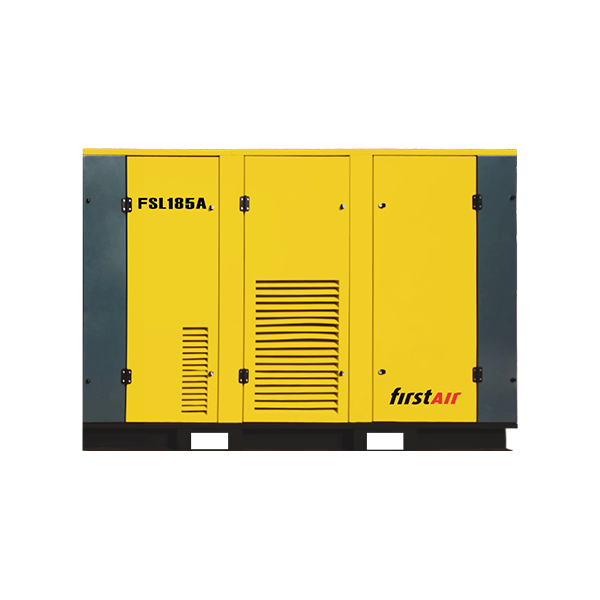
The FSL series covers models from FSL30A and FSL37A to FSL37A-3, FSL45A-3, FSL55A-3, FSL75A-3, FSL90A-3, FSL110A-3 and FSL160A-3, with power from 30 kW to 160 kW; the 0.3 MPa models deliver from 10.5 m³/min to 44.0 m³/min.
The air outlet pipe size grows with the model, from Rp2 up to DN125 (JB/T81-1994); the connections follow standard configurations for easy tie-in to the site network. Unit dimensions and weight also rise with power, which can be used to plan installation space during selection and layout.
For the advantages of a low-pressure unit to reach actual use, the system around it must cooperate:
| Item | Specification |
|---|---|
| Working pressure | 0.3 - 0.45 MPa |
| Air delivery | 6.0 - 50.8 m³/min |
| Power range | 30 - 220 kW |
| Model series | FSL30A, FSL37A, FSL37A-3 to FSL160A-3 |
| Air outlet pipe size | Rp2 - DN125 (JB/T81-1994) |
The pressure, air delivery, dimensions and weight of each model are listed in the full parameter table at the bottom of the page.
Saving energy is not about turning parameters down but about running equipment at the duty point actually required. With a 0.3-0.45 MPa low-pressure design and 6.0-50.8 m³/min of high flow, the ESSENCE FSL series makes doing less useless work a product logic. For low-pressure, high-flow processes, choosing the right pressure level is often more direct than retrofitting a standard machine for efficiency. As a brand of Fusheng Group, ESSENCE draws on the group's R&D and service system to provide lasting support for low-pressure air applications.
| kW/HP | MPa m³/min dB(A) L×W×H kg |
|---|---|
| Working Pressure | 0.3~0.45 MPa; air delivery 6.0~50.8 m³/min; power range 30~220 kW |
| Working Pressure | 0.3~0.45 MPa |
| Air Delivery | 6.0~50.8 m³/min |
| Power Range | 30~220 kW |




Give us your working pressure, air demand and site conditions, and we will confirm the model and configuration