In factories with heavy electricity use, the compressor room is often the most conspicuous line on the power bill. The higher the power, the more significant the waste from load/unload control: the machine runs at full speed, surplus air is vented, and every cubic metre vented represents electricity actually consumed. Once power climbs into the tens or even hundreds of kilowatts, the surge on the grid at start-up and the wear on the machine are amplified as well.
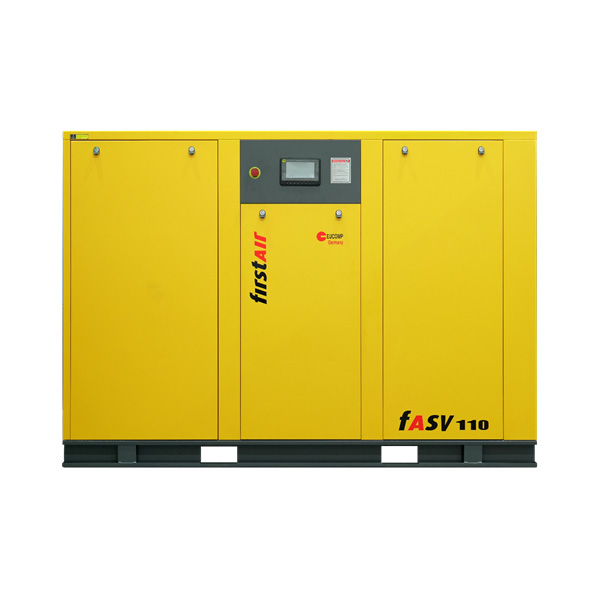
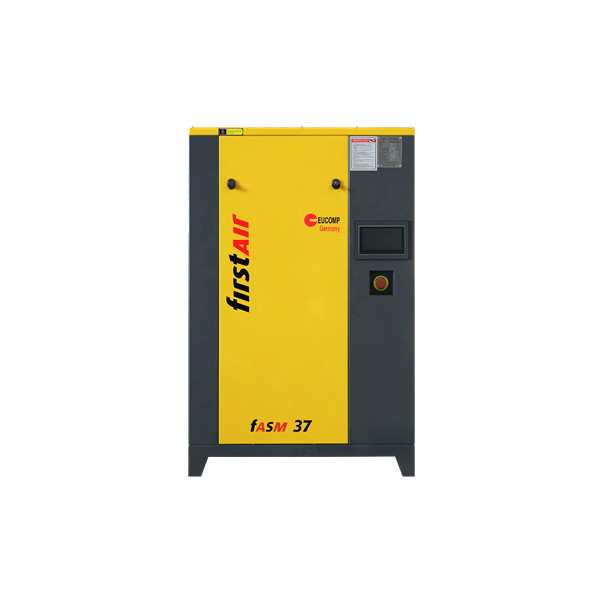
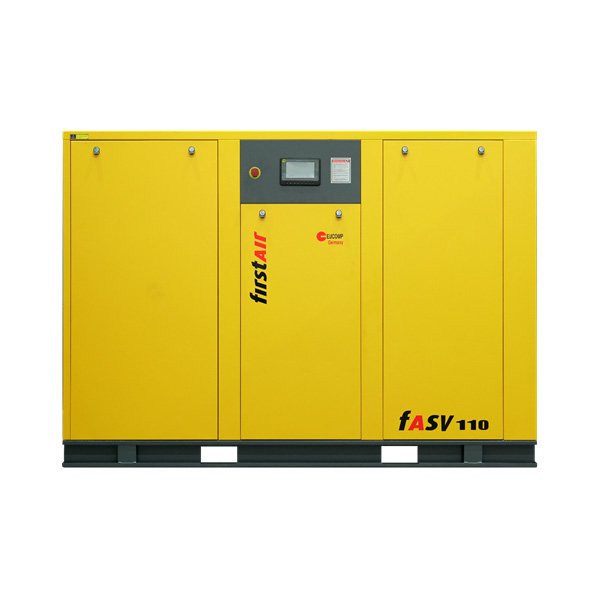
The ESSENCE FASV VSD screw air compressor covers models from FASV45A-*M to FASV132A-*M, with a power range of 45-300kW, air delivery of 2.52-55.00m³/min and working pressure of 0.7-1.25MPa. It uses PM VSD starting and coupling drive, and its voltage/frequency covers 220/380/415/440V, 50/60Hz. It is the brand's main platform in the high-power range.
The higher the power, the higher the cost of running unloaded. If a screw compressor above 45kW stays in load/unload mode for long periods, the motor keeps spinning at full speed while unloaded, and that energy produces no useful air delivery. VSD control changes this logic: speed varies continuously with air demand, so you pay for the air you actually use.
In the FASV data sheet, this on-demand capability shows up as the difference in air delivery for the same model at different pressures. Take the 45kW model: at 0.7MPa the air delivery is 3.12-7.80m³/min, while at 1.25MPa it is 2.52-6.30m³/min. The model's own control range, together with the VSD drive's real-time speed control, determines how well it tracks a fluctuating air demand.
This kind of waste never shows up in the fault log, yet it appears reliably on every month's power bill—which is why VSD deserves serious attention at high power.
When a high-power motor starts direct-on-line, the starting current can reach several times the rated current. This not only demands more grid capacity but can also affect the normal operation of other equipment on the same distribution system.
FASV uses PM VSD starting, so the start-up is smooth and the impact on the grid and the machine is smaller. For factories whose distribution capacity is already tight, this can be worth more than the energy savings alone—it may mean no need to upgrade the distribution system just to add a compressor.
FASV's voltage/frequency is rated at 220/380/415/440V, 50/60Hz, covering several common power systems. This lets one electrical platform adapt to the supply conditions of different regions, making selection and spare-part management easier for companies with plants in multiple locations or under different grid environments.
The drive is a coupling drive. In the medium-to-high power range, the efficiency and reliability of the drive directly affect how the unit performs over the long run. A coupling drive is direct in structure and offers good load capacity, suits long continuous running, and avoids the belt-tensioning and belt-replacement maintenance that belt drives require.
In addition, the data sheet's aftercooler outlet temperature ≤ ambient + 15°C means the air temperature entering the treatment equipment is controlled, easing the load on the refrigerated dryer and filters.
The FASV models run in order: FASV45A-*M, FASV55A-*M, FASV75A-*M, FASV90A-*M, FASV110A-*M and FASV132A-*M, at power points of 45, 55, 75, 90, 110 and 132kW. At 0.8MPa, for example, the air deliveries of the six models are 3.04-7.60, 3.84-9.60, 5.20-13.00, 6.08-15.20, 7.92-19.80 and 9.60-24.00 m³/min respectively, in fairly even steps.
Even steps matter because when air demand changes, you can move smoothly up or down within the same series instead of replacing the whole solution. For companies ramping up capacity or investing in phases, this scalable model matrix is more practical than a single all-in-one machine.
| Item | Specification |
|---|---|
| Working pressure | 0.7 ~ 1.25 MPa |
| Air delivery | 2.52 ~ 55.00 m³/min |
| Power range | 45 ~ 300 kW |
| Starting method | PM VSD starting |
| Voltage/frequency | 220/380/415/440V, 50/60Hz |
| Drive | Coupling drive |
| Aftercooler outlet temperature | ≤ ambient + 15°C |
| Air outlet | G2 / flange DN80, DN100 |
Selecting a high-power compressor is essentially about balancing upfront investment against long-term operating cost. With PM VSD starting, coupling drive and wide-voltage compatibility, FASV tips the scales toward the latter—for a plant that runs continuously all year, that is the side that pays off.
When choosing, it helps to settle three questions in order: how high the pressure must be, how much air is needed, and how much weight the power bill carries. The answers will point naturally to the right model—not to the most eye-catching one on the data sheet.
| Starting Method | Type: PM VSD start |
|---|---|
| Voltage / Frequency | V/Hz 220/380/415/440V、50/60Hz |
| Aftercooler Outlet Temperature | °C ≤ ambient temperature +15 °C |
| Drive Method | Coupling drive |
| Air Outlet | in. Flange DN80, JB/T81-1994; Flange DN100, JB/T81-1994 |
| Working Pressure | 0.7~1.25 MPa; air delivery 2.52~55.00 m³/min; power range 45~300 kW |
| Working Pressure | 0.7~1.25 MPa |
| Air Delivery | 2.52~55.00 m³/min |
| Power Range | 45~300 kW |




Give us your working pressure, air demand and site conditions, and we will confirm the model and configuration