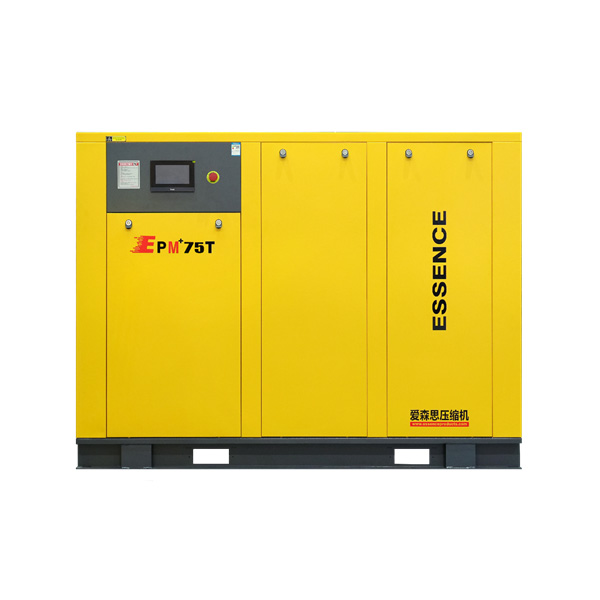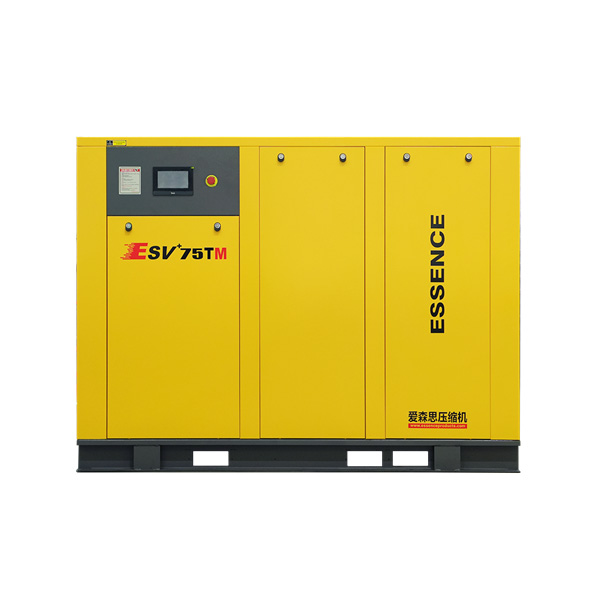
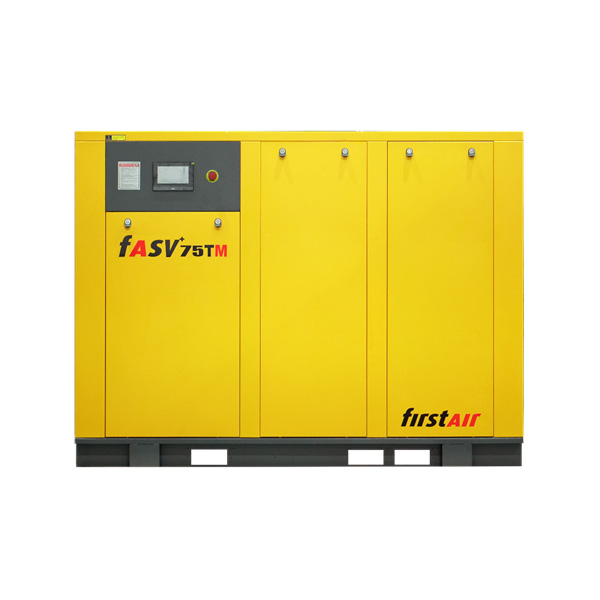
Within the same power range, how finely the models are stepped often decides whether a machine is a "just right" fit. If the only choices are 55kW and 75kW, a plant whose air demand falls between them has to size up; the denser the steps, the easier it is to find the unit that matches the need.
The ESSENCE FASV+-TMA two-stage high-efficiency PM VSD screw air compressor offers exactly this kind of fine stepping. It comprises eight models — FASV+22A*TMA, FASV+37A*TMA, FASV+45A*TMA, FASV+55A/W*TMA, FASV+75A/W*TMA, FASV+90A/W*TMA, FASV+110A/W*TMA and FASV+132A/W*TMA — covering 22–132kW with a working pressure of 0.7–1.25MPa. ESSENCE is a wholly owned subsidiary of Fusheng Group, and its products are backed by Fusheng's technology and service system. Voltage/frequency coverage spans 220/380/415/440V and 50/60Hz, so the units adapt to different regional power grids — a particular advantage for companies with export business.
Eight power steps run from 22kW up to 132kW, with small gaps between adjacent steps. The direct benefit to the user is that a model matching actual air demand is easier to find, cutting the long-term energy waste of oversizing and the overload risk of undersizing. For plants that bring production lines on stream in phases and ramp up air demand step by step, the fine steps mean every expansion stage has a corresponding model. Note that the eight models are not simply spread evenly by power; they are divided around common air-demand levels so that each step maps to a real demand range.
Air heats up as it is compressed, and the hotter it gets, the more power it takes to keep compressing. Two-stage compression splits the process into two stages, cooling the air in between before it enters the second stage, so the air reaches the later stage at a lower temperature and smaller volume, reducing overall compression work. This structure shows its advantage most clearly at higher pressures, and it is the technical basis for the FASV+-TMA series' "high-efficiency" positioning. In other words, two-stage compression is not about making the machine more complicated; it uses more sensible heat management to recover the efficiency that high temperatures would otherwise consume.
The easiest mistake in selection is looking only at the "maximum air delivery". These models list air delivery at each pressure so it can be checked directly:
| Model | 0.7MPa | 0.8MPa | 1.0MPa | 1.25MPa |
|---|---|---|---|---|
| FASV+22 | 1.80~4.50 | 1.72~4.30 | 1.36~3.40 | 1.16~2.90 |
| FASV+37 | 2.96~7.40 | 2.88~7.20 | 2.40~6.00 | 2.24~5.60 |
| FASV+45 | 4.16~10.40 | 3.92~9.80 | 3.50~8.75 | 3.08~7.70 |
| FASV+55 | 5.12~12.80 | 4.80~12.00 | 4.28~10.70 | 3.76~9.40 |
| FASV+75 | 7.00~17.50 | 6.60~16.50 | 5.84~14.60 | 5.16~12.90 |
| FASV+90 | 8.32~20.80 | 7.88~19.70 | 6.76~16.90 | 5.84~14.60 |
| FASV+110 | 9.80~24.50 | 9.00~22.50 | 7.84~19.60 | 7.12~17.80 |
| FASV+132 | 12.00~30.00 | 11.20~28.00 | 9.36~23.40 | 8.60~21.50 |
(Air delivery in m³/min)
The pattern is clear: the higher the pressure, the lower the air delivery for the same model. So the right approach is to fix the usual working pressure first, then match air delivery in that column rather than taking the maximum across the row.
| Item | Specification |
|---|---|
| Number of models | 8 (22 / 37 / 45 / 55 / 75 / 90 / 110 / 132 kW) |
| Power range | 22 ~ 132 kW |
| Working pressure | 0.7 ~ 1.25 MPa |
| Air delivery | 1.16 ~ 30.00 m³/min |
| Starting method | PM VSD |
| Voltage/frequency | 220/380/415/440V, 50/60Hz |
| Drive | Coupling drive |
| Aftercooler outlet temperature | ≤ ambient + 15°C |
| Air outlet | G1 1/4 / G2 / square flange DN80 / flange DN80 |
The units use PM VSD starting, with speed adjusted continuously to air demand to cut no-load waste. The coupling drive keeps the structure simple and routine maintenance items few. Aftercooler outlet temperature is held within ambient + 15°C, easing the load on downstream drying and filtration equipment. Air outlets are fitted by model with G1 1/4, G2, square flange DN80 or flange DN80, with port sizes scaling up along with the power step to suit plant piping networks of different scales.
In addition, all eight models use PM VSD starting and coupling drive, keeping the control method and maintenance practice consistent, so a company can standardise its O&M even when different power steps are installed in different workshops.
The ideal in selection is a machine that fits the working conditions "just right". With eight power steps and complete data at four pressure points, FASV+-TMA makes that judgement easier. For a plant that cannot estimate its air demand precisely, a model range with fine steps and complete data is itself a form of risk control. For procurement, rather than agonising over a few widely spaced steps, it is better to choose a series with finer steps and fuller data, and let selection come back to the data itself.
| Starting Method | Type: PM VSD start |
|---|---|
| Voltage / Frequency | V/Hz 220/380/415/440V、50/60Hz |
| Aftercooler Outlet Temperature | °C ≤ ambient temperature +15 °C |
| Drive Method | Coupling drive |
| Air Outlet | in. Flange DN80, JB/T81-1994; Flange DN100, JB/T81-1994; Flange DN100, JB/T81-1994 |
| Working Pressure | 0.7~1.25 MPa; air delivery 1.16~73.00 m³/min; power range 22~355 kW |
| Working Pressure | 0.7~1.25 MPa |
| Air Delivery | 1.16~73.00 m³/min |
| Power Range | 22~355 kW |




Give us your working pressure, air demand and site conditions, and we will confirm the model and configuration